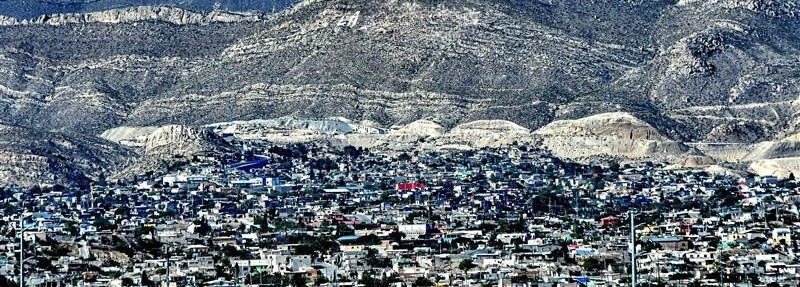
U.S. - Mexico Border
The air we breathe: Expanding the Monitoring Network in Ciudad Juarez, Mexico
Prepared by: Abigail Pérez, Zulima Leal, Adrián Peña, Mauricio Mora
Did you know that since 2018, more than half of the world's population has been living in cities? In Mexico, that percentage is 65.5%, and in the northern border region it reaches 94%. While urbanization brings important benefits, it also creates environmental challenges, such as increased demand for water and basic services, greater infrastructure needs, and in some cases, worsening air pollution in cities.
This post examines the challenges and progress being made to achieve cleaner air in Ciudad Juarez, Chihuahua, where the North American Development Bank (NADBank) is working with institutions on both sides of the border to expand the air quality monitoring network. This expansion is key to obtaining accurate real-time measurements that help prioritize mitigation actions and issue early alerts to the community.
Ciudad Juarez: challenges of a shared border
Ciudad Juarez borders the cities of El Paso, Texas, and Sunland Park, New Mexico. Together, they form the second-largest binational metropolitan area between Mexico and the United States, known as the Paso del Norte Region.
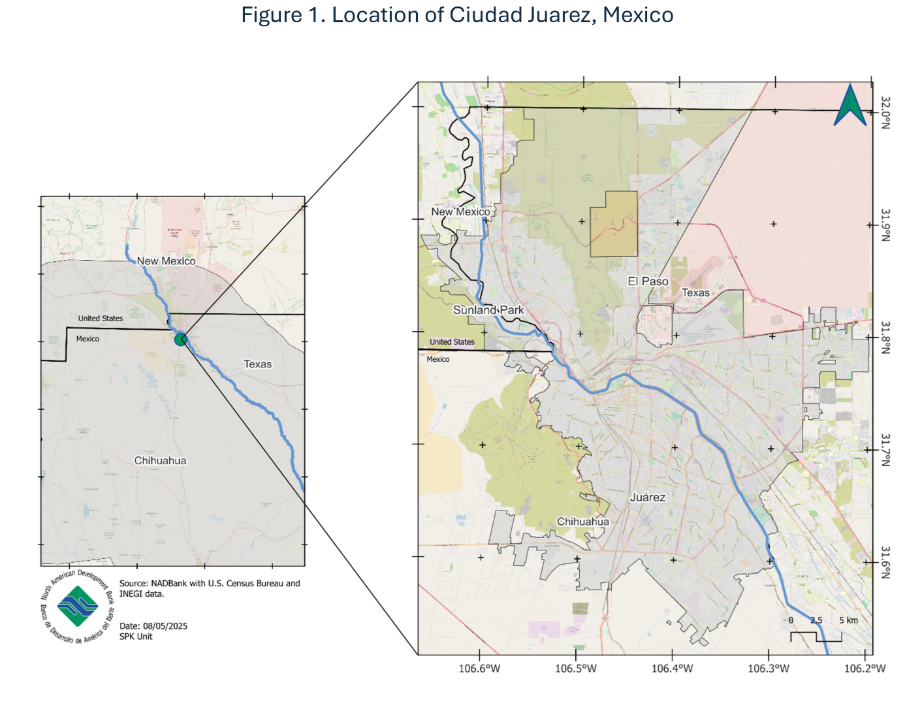
Local conditions. The climate in the region is extreme, and precipitation is scarce due to its geographic location in the Chihuahuan Desert. Over the past 10 years, the area has experienced rising temperatures, decreasing rainfall and more intense drought periods. These changes harm biodiversity, reduce water sources and degrade soil quality. They also increase the frequency of dust storms, which elevate concentrations of particulate matter (PM) that penetrate deeply into the lungs, damaging tissue and increasing the incidence of respiratory and cardiovascular diseases.
Urban pressures. Air quality is also affected by anthropogenic pressures. Between 1990 and 2020, Ciudad Juarez experienced an average annual population growth of 2.17%, nearly double the national average. In addition, the lack of an efficient public transportation system increased dependence on private vehicles, reaching an average of one car for every two residents (IMIP, 2025). As a result, emissions from the combustion of fossil fuels have contributed to the formation of ozone (O₃), a gas that irritates the respiratory tract and worsens chronic conditions such as asthma.
How can we measure air quality problems?
Criteria pollutants are commonly used as indicators of air quality, as they can affect human health, the environment and ecosystems. These pollutants include particulate matter (PM), ozone (O₃), carbon monoxide (CO), sulfur dioxide (SO₂), nitrogen dioxide (NO₂), and lead (Pb). The monitoring of these pollutants was established in the U.S. in 1970 through the Clean Air Act, which influenced the development of environmental policies and solutions in other countries. In Mexico, the legal framework for environmental protection and air quality was established in 1988.
Air quality assessment relies on various complementary monitoring methods that provide reliable information, verify compliance with environmental standards, and support public policy decision-making. Below are some examples:
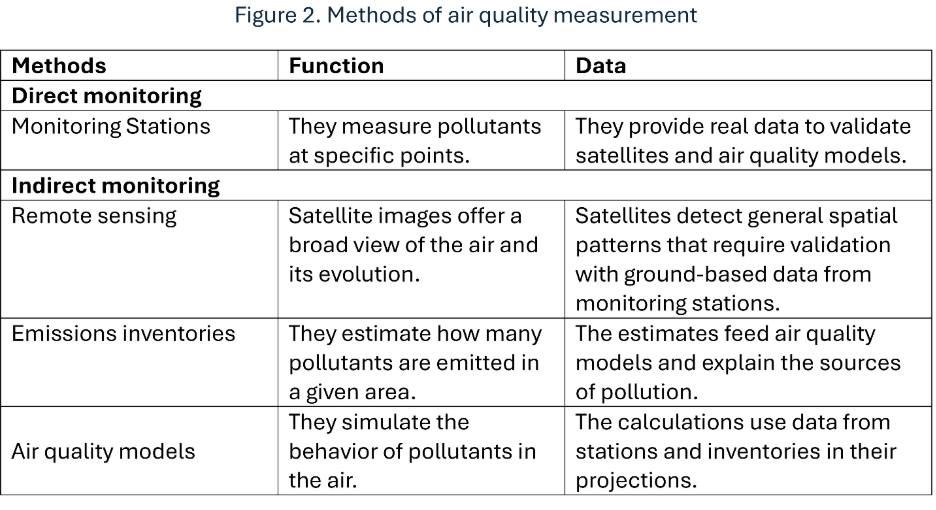
This publication focuses solely on the results of data evaluations from the air-monitoring stations in Ciudad Juarez.
Bilateral cooperation
In light of increasing cross-border activity and air quality challenges caused by economic growth and urban emissions, in 1996, an addendum was added to the Agreement on Cooperation for the Protection and Improvement of the Environment in the Border Area (the 1983 La Paz Agreement between the U.S. and Mexico). This addendum emphasized the importance of community involvement in improving air quality (U.S. Department of State, 1983). As a result, the Joint Advisory Committee (JAC) was created to develop and recommend initiatives to improve air quality in the Paso del Norte region (JAC, 2025).
The structure of the JAC is unique and exemplifies binational cooperation, bringing together the three levels of government, academia, citizens and non-governmental organizations from both countries. Among the JAC's efforts is the expansion of the monitoring network in Ciudad Juarez, carried out through the Binational Air Quality Monitoring Fund (AQF), which operates with contributions from the Texas Commission on Environmental Quality (TCEQ), the El Paso Community Foundation, the Association of Vehicle Inspection Center Concessionaires of Ciudad Juarez and NADBank.
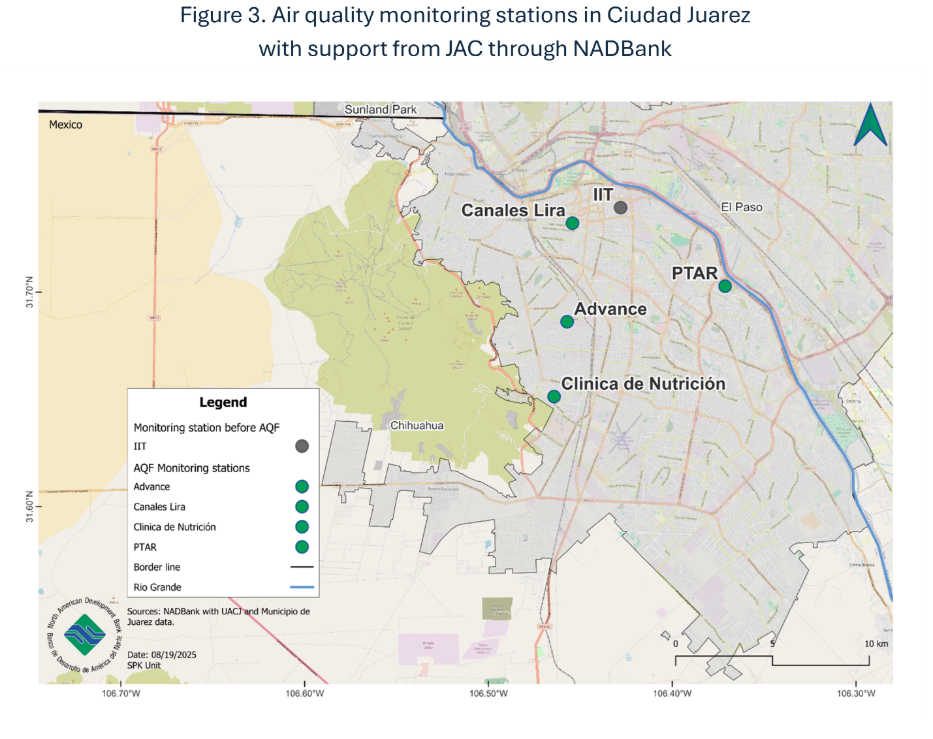
Through this initiative, the number of monitoring stations increased from one to five: three in the northern part of the city near the border (IIT, Canales Lira, PTAR), one in an industrial park to the west (Advance), and another on the urban edge near the Sierra de Ciudad Juarez to the southwest (Clinica de Nutricion).
Although intermittent air quality monitoring activities have taken place in Ciudad Juarez since 1991, the current network began operating in 2019 with a station managed by the Universidad Autonoma de Ciudad Juarez (UACJ). Since then, this infrastructure has evolved and remained operational with support from the AQF, providing continuous air quality information and enabling progress in the assessment of ozone (O₃) and particulate matter (PM) in the region.
How Juarez breathes
To evaluate air quality in the city (ozone and PM), we analyzed data from the five stationsiii operated by UACJ and reported to the municipal government, obtaining the following results:
Ozone
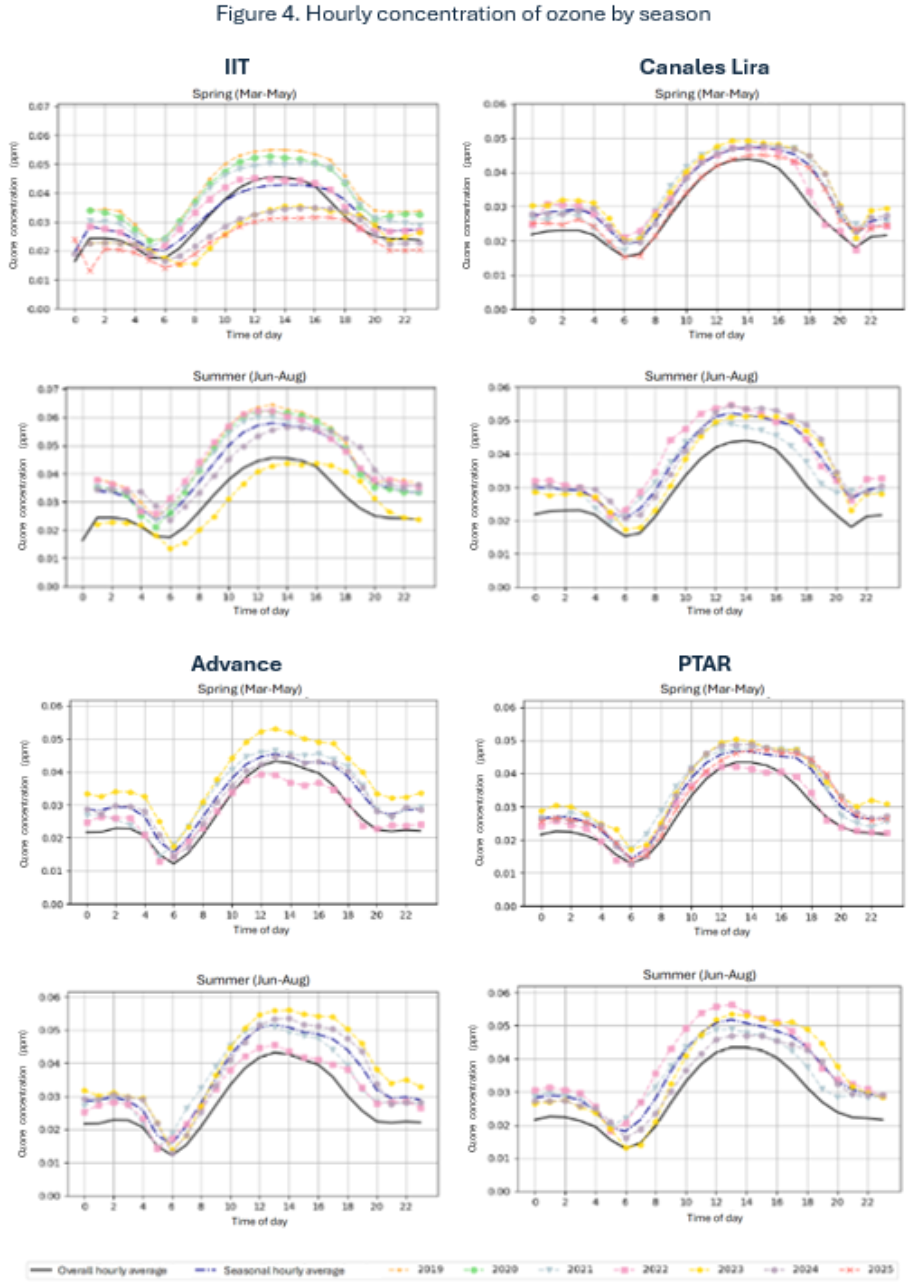
Ozone varies according to solar radiation, with higher levels in spring and summer. It begins forming around 6:00 a.m., reaches its peak at 2:00 p.m., and maintains elevated concentrations between 4:00 p.m. and 6:00 p.m.
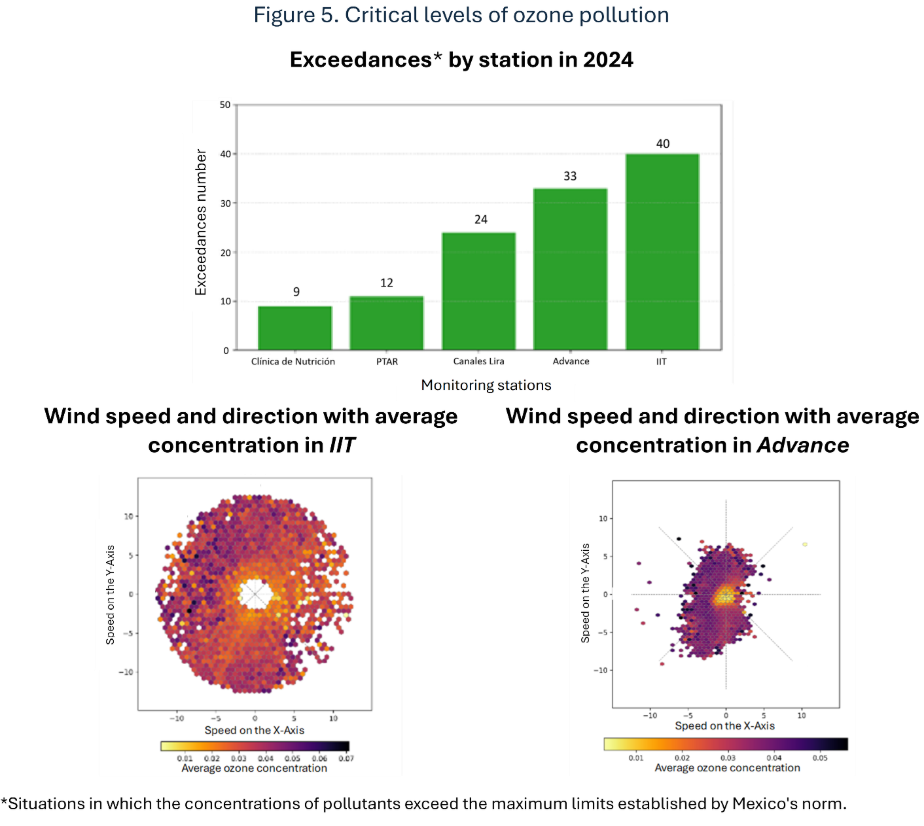
In 2024, ozone concentrations that exceeded the limits established by the Mexican Ministry of Health were more frequent at the IIT station, located 2.17 miles from the Cordova-Americas International Bridge, the point with the highest heavy-truck traffic in the area. However, the highest ozone concentrations were observed at the Advance station, located in the Fernández Industrial Park, where industrial traffic and emissions from metal-processing maquiladoras may contribute to ozone formation.
Particulate Matter (PM)
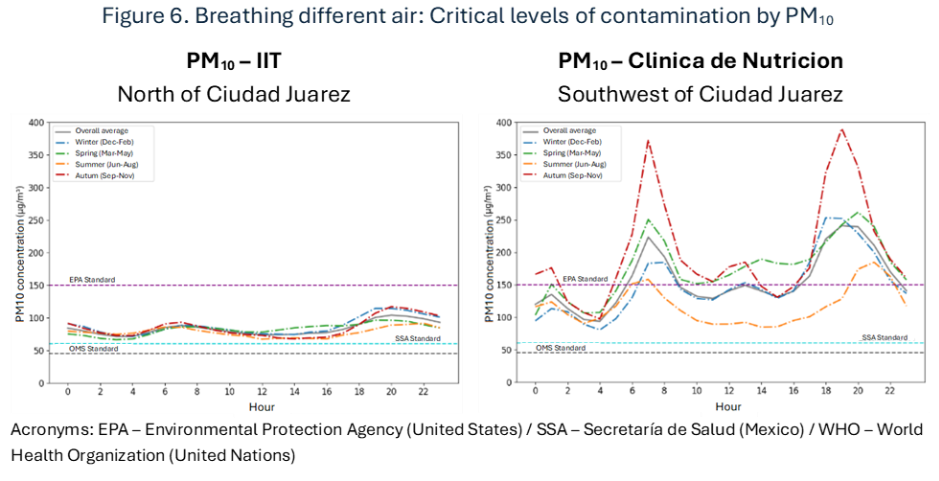
Particulate matter, influenced by wind, varies significantly throughout the year, with higher levels in fall and winter and, occasionally, in spring. Hourly concentrations also increase during the morning (6:00 am-8:00 am) and at night (6:00 pm-8:00 pm).
The data shows that not all residents of Ciudad Juarez breathe the same air, due to differences in vegetation, topography, and paved surfaces. The greatest contrast is observed between the IIT station and the Clinica de Nutricion station, located in the southwestern part of the city. In 2024, the average PM10 pollution level in the southwest was 3.8 times higher than the national limit, reaching 136.24 μg/m³. Pollution at specific hours, together with wind speed, indicates that unpaved roads near the Sierra de Juarez mountains lift dust and particulate matter into the air. Paving key roads in the southwest could significantly reduce PM₁₀ pollution, which is highly harmful to public health.
Conclusion
Variations in the concentrations of the main pollutants in Ciudad Juarez highlight the importance of focusing efforts on projects that address intra-urban differences. They also underscore the need to expand and diversify the monitoring network to obtain precise and reliable data.
Air quality, a priority sector for NADBank, has been a central topic in collaborative initiatives with institutions such as UACJ, JAC and TCEQ, demonstrating that it is possible to make progress together toward a healthier environment for all. Ultimately, commitment and innovation in the measurement and monitoring of pollutants are essential for planning actions to improve air quality in the region.
Works cited
IMIP. (2025). Radiografía socioeconómica del municipio de Juárez 2024, así comenzó 2025. https://www.imip.org.mx/imip/files/radiografia/Radiografia2024-2025.pdf
JAC. (2025). Joint Advisory Committee (JAC). https://www.cccjac.org/history.html
U.S. Department of State. (1983). ENVIRONMENTAL COOPERATION Agreement Between the UNITED STATES OF AMERICA and MEXICO. https://www.epa.gov/sites/default/files/2015-09/documents/lapazagreement.pdf
.png?width=500&name=Keynote%20Speakers%20(11).png)

.jpeg?width=500&name=WhatsApp%20Image%202025-08-29%20at%201.03.38%20PM%20(2).jpeg)