
April 27, 2026
Ground broken to rehabilitate additional wastewater collection and conveyance infrastructure in the Tijuana River Area of Baja California
.jpeg)
Tijuana, Baja California – As part of the ongoing water infrastructure upgrades under development in the municipality, ground was officially broken on the rehabilitation of Lift Stations PB1A and PB1B, which will strengthen wastewater conveyance and management services for approximately one million residents.
During the event, the North American Development Bank (NADBank) and the local water utility, Comisión Estatal de Servicios Públicos de Tijuana (CESPT) executed a grant agreement to support a new project involving the replacement of 35,708 ft of deteriorated pipeline in 13 critical sections of the wastewater collection system, which will prevent sewage spills and keep untreated wastewater from reaching the Tijuana River.
These projects are part of NADBank’s efforts to support implementation of the commitments established in the Memorandum of Understanding (MOU) signed by the U.S. Environmental Protection Agency (EPA) and the Ministry of Environment and Natural Resources (SEMARNAT), as well as in Minute 333 executed in 2025 by the U.S. and Mexican Sections of the International Boundary and Water Commission (IBWC) to address transboundary wastewater problems in the Tijuana-San Diego region.
Baja California Governor Marina del Pilar Ávila Olmeda presided over the event, along with NADBank Managing Director John Beckham, EPA Water Division Director Tomas Torres, and CESPT General Manager Mónica Juliana Vega Aguirre.
“Projects such as this one demonstrate our shared objective—to put citizens on both sides of the border first,” said Baja California Governor Marina del Pilar Avila Olmeda “Today, we are taking a decisive step forward in modernizing the infrastructure that underpins the responsible management of wastewater in our state, as well as in the United States.”
In his remarks, John Beckham stated that “NADBank has been instrumental in fostering collaboration among stakeholders and officials at all levels of government in both countries to invest in durable infrastructure and lasting solutions to address wastewater flows caused by rapid population growth and aging sewer systems in Tijuana. These investments will be the foundation for ensuring the well-being and prosperity of this dynamic city and its border neighbors.”
He added that, to date, more than US$32 million in grants provided through the Border Environment Infrastructure Fund (BEIF)—which is funded by EPA and administered by the Bank—is being invested in the Tijuana metropolitan area to support 11 of the 22 projects defined in IBWC Minute 328 to clean up the Tijuana River. Seven of those projects have already been completed, and four are currently under construction. These funds are being supplemented by nearly $60 million contributed by Mexico.
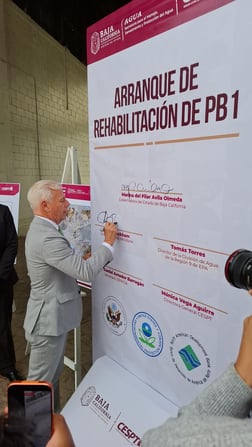
The rehabilitation of Lift Stations PB1A and PB1B are two components of a project approved in 2024 to receive a US$13.44-million BEIF grant. The project also includes replacement of the International Collector, rehabilitation and expansion of Lift Station PBCILA from 23 million to 34 million gallons a day (mgd), and construction of a new intake from the Tijuana River channel to PBCILA. In addition to the BEIF grant, the US$30.9-million project is receiving funding from the Mexican federal government through the Ministry of National Defense (SEDENA) and the National Water Commission (CONAGUA).
“These works generate direct benefits for people on both sides of the border by reducing transboundary wastewater flows,” stated CESPT General Manager Mónica Juliana Vega A
guirre. “The rehabilitation of Lift Station PB1 will positively impact approximately 1,050,695 residents by ensuring safer and more efficient wastewater management.”
The US$4.2-million grant agreement signed by NADBank and CESPT will provide funding for the rehabilitation of sewer lines in the Tijuana River area.

NADBank is a financial institution established and capitalized in equal parts by the United States and Mexico for the purpose of financing environmental infrastructure projects along their common border. As a pioneer institution in its field, the Bank is working to develop environmentally and financially sustainable projects with broad community support in a framework of close cooperation and coordination between Mexico and the United States. For more information about NADBank, visit www.nadb.org.